From Apollo to AI: The 50-Year Rocket Ride of Cybersecurity
From Apollo to AI: The 50-Year Rocket Ride of Cybersecurity
From Apollo to AI: The 50-Year Rocket Ride of Cybersecurity
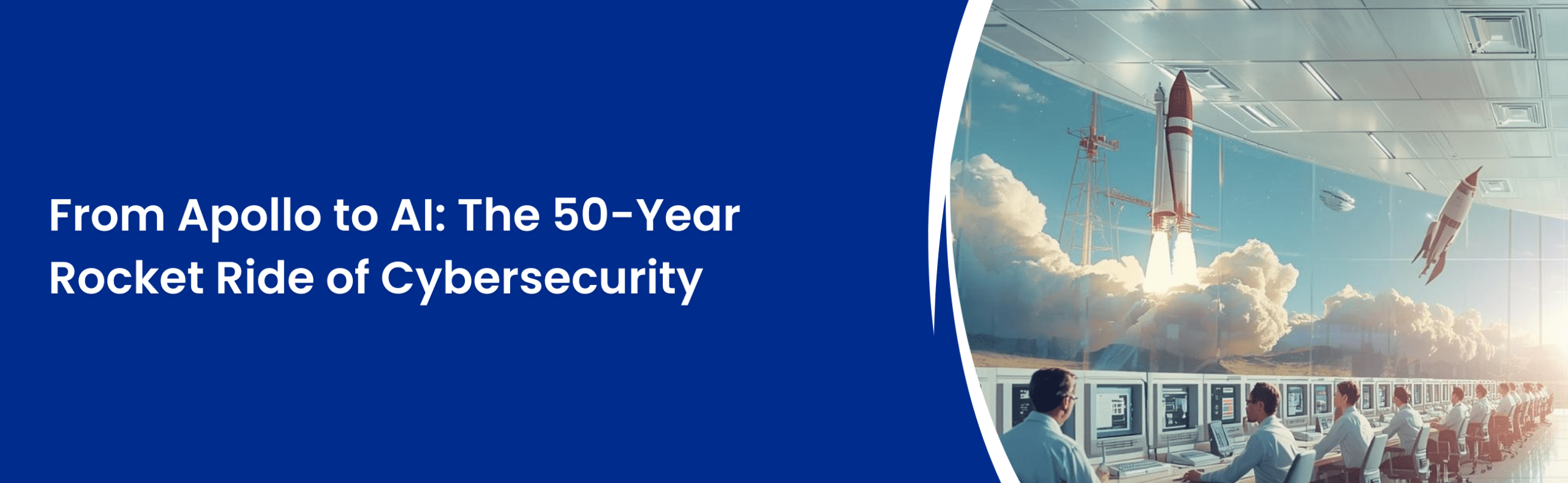
Imagine telling an Apollo mission engineer in 1969 that in fifty years, humanity’s greatest threat wouldn’t be fiery rocket launches or the vacuum of space, but invisible lines of malicious code capable of paralyzing hospitals, hijacking pipelines, and stealing the identities of millions from a basement halfway across the globe. The term “cyber” barely existed then. Today, it’s woven into the fabric of our daily lives. The evolution of cybersecurity is not a slow, academic crawl; it’s a breakneck, 50-year rocket ride mirroring—and defending against—the explosive growth of technology itself. This journey, from trusted mainframes to today’s hyper-connected cloud, reveals a relentless arms race between defenders and a constantly morphing adversary.
The Age of Innocence (Pre-1990s): Curiosity and Containment
In the beginning, there was no “cybersecurity.” There was simply computer security, a physical and logical concern for the handful of room-sized mainframes humming in government and university labs. The network, where it existed (like the embryonic ARPANET), was a closed club of trusted academics and researchers. Threats were theoretical or playful. The 1971 “Creeper” worm, an experimental self-replicating program, was more a proof-of-concept than a weapon, famously answered by the “Reaper,” the world’s first antivirus program created to delete it. This was the era of the “garage hacker,” motivated by intellectual curiosity and the challenge of bypassing system limits. Security focused on physical access control and simple login credentials. The core components we know today were undeveloped; network security meant guarding the single wire, and data security meant locking the tape storage room.
The Wild West (1990s): The Internet Opens the Floodgates
The commercialization of the internet in the 1990s changed everything. As businesses and millions of users came online, the attack surface exploded. The era of playful curiosity gave way to the era of disruption and notoriety. The Melissa virus (1999) and the ILOVEYOU worm (2000) were global shocks, spreading via email with devastating speed and financial impact, demonstrating how interconnected vulnerability had become. Application security, especially for new web-based services, became a glaring concern. In response, cybersecurity commercialized. Standalone antivirus software became a household necessity, and the firewall emerged as the digital frontier’s fortress wall, defining early network security. This decade was the “Wild West,” where the rules were being written in real-time, establishing the foundational layer of defense we now call endpoint security.
The Gold Rush (2000s): Crime Pays and Defense Matures
If the 90s were about disruption, the 2000s were about profit. Cybercriminals realized there was vast wealth in data and system access. This was the decade of the mega-breach, with hackers targeting retailers and corporations to harvest oceans of credit card numbers and Personal Identifiable Information (PII). Data security transformed from an IT task into a core business and legal imperative, driven by regulations like HIPAA and PCI DSS. Phishing emails replaced flashy viruses as the weapon of choice, exploiting human psychology. The rise of identity management systems became critical to ensure only legitimate users accessed sensitive resources.
Simultaneously, the landscape grew more complex with the advent of Web 2.0, social media, and always-on connectivity. Defense could no longer rely on a simple perimeter. The concept of disaster recovery and business continuity planning moved from the back office to the boardroom, as companies realized a cyber-attack could mean an existential threat. Security became less about just keeping bad code out and more about protecting critical assets—the mission-critical applications and databases—from determined intruders who might already be inside.
The Age of Asymmetry (2010s-Present): Statecraft, Cloud, and Complexity
The last decade shattered any remaining notion of cybersecurity as a purely criminal problem. The revelations of state-sponsored campaigns like Stuxnet demonstrated cyber’s potential as a tool of geopolitical sabotage. Advanced Persistent Threat (APT) groups, often nation-state backed, operated with surgical precision, lurking in networks for years to steal intellectual property or conduct espionage. The targets expanded to include power grids, elections, and critical infrastructure.
Technologically, two seismic shifts redrew the battle lines: mobile and cloud. The smartphone put a powerful computer—and a new target (mobile security)—in everyone’s pocket. The migration to cloud services (IaaS, PaaS, SaaS) dissolved the traditional network perimeter entirely. Data now lived in Amazon Web Services, Microsoft Azure, or Google Cloud, making cloud security a shared responsibility model and a top priority.
This complexity bred new defensive philosophies. The “castle-and-moat” model was declared obsolete. The Zero Trust security model framework emerged, operating on the principle of “never trust, always verify,” requiring strict identity management and micro-segmentation at every access attempt. As attacks grew more sophisticated, so did the response, incorporating artificial intelligence and machine learning to detect anomalies in real-time. Crucially, the human element was finally formally recognized. End-user education became a dedicated cybersecurity component, the last line of defense against social engineering that high-tech tools couldn’t always stop.
The Next Frontier: AI, IoT, and the Unseen Battle
Today, the rocket ride is accelerating. We stand at the edge of a new frontier defined by artificial intelligence, the Internet of Things (IoT), and quantum computing. AI is a double-edged sword, empowering defenders to analyze threats at superhuman speeds while also giving attackers tools to create hyper-realistic deepfakes and automate sophisticated attacks. Billions of poorly secured IoT devices—from smart thermostats to medical implants—create a vast, fragile attack surface. The looming advent of quantum computing threatens to break the fundamental encryption that secures all modern digital communication.
The evolution from Apollo to AI teaches us one fundamental lesson: cybersecurity is a process, not a product. It is a continuous cycle of adaptation. The core components—from network and endpoint security to cloud security and user education—are not standalone solutions but interconnected layers of a dynamic defense. The hacker in the basement has been joined by organized crime syndicates and nation-state armies. Our mission, no less critical than landing on the moon, is to build digital systems and a security-aware culture that can endure this perpetual storm. The next 50 years of our digital journey depend not just on the technology we create, but on our unwavering commitment to defending it. The ride is only getting faster.

Ajai Srivastava,
Founder Director of Seven Step Consulting Pvt. Ltd. , which comprises GRC Consulting, GRC Automation, and Books Publication, brings 35+ years of leadership across multinational companies. A seasoned consultant, auditor, trainer, and author, he is known for shaping ISMS in India, delivering 3000+ training hours, and advancing global standards and compliance practices.